 Die Chronik-Seiten der SEMPEROPER EDITION
Elfride Trötschel A life for the opera

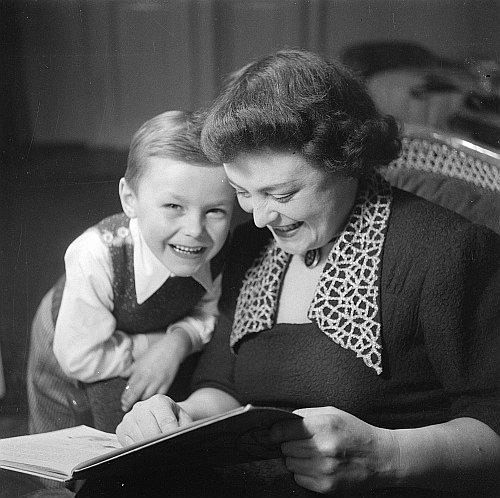
Elfride Trötschel with her son Andreas before the performance of the Barber of baghdad at the Berlin Staatsoper in July 1951
© Photo: Privat artist album of Elfride Trötschel
dass längst verloren geglaubte Tondokumente meiner Mutter
wieder aufgetaucht und nun veröffentlicht sind”…
Seiteninhalt
| → | Authentizität im Rundfunk mit Dr. Andreas Trötschel als Studiogast |
| → | Andreas Trötschel’s personal memories |
| → | • “Little Trötschel” |
| → | • Lyrical intensity |
| → | • Artistic allurement |
| → | • Concerts with new music |
| → | • Revelations in song |
| → | • Opera of the 20th century |
| → | • Symphonic |
| → | SLIDESHOW Photographic memories |
Dankbar und sichtlich bewegt, spricht Dr. Andreas Trötschel diese Worte zur Hörerschaft des Kulturkanals MDR FIGARO. Anlass für seine Mitwirkung als Studiogast ist eine Opernsendung zu Leben und Wirken der hochbeliebten, leider viel zu früh verstorbenen Sängerin Elfride Trötschel.
Im Winter, im Sitzungssaal des Deutschen Hygiene Museums in Dresden, im einzig erhalten gebliebenen Saal Dresdens, wurde die gesamte Oper an nur einem Tag aufgenommen natürlich ohne Korrekturen, mit nur einem Mikrofon. Die Musiker haben dabei gefroren und die Harfe verstimmte sich bei diesen Temperaturen immer mehr. Authentischer kann keine Aufnahme sein!“
Seine Worte der Liebe, Zuneigung und Sympathie, die Dr. Andreas Trötschel in seinen Erinnerung an die Mutter fand, sprangen von ihm geradezu spontan auf die interaktiv einbezogenen Hörer der Sendung über.

In the MDR FIGARO studio on the occasion of a broadcast about the Dresden production of Rusalka: Dr Andreas Trötschel, son of the singer Elfride Trötschel, 2007
© Foto: Steffen Lieberwirth
MDR FIGARO Elfride-Trötschel-Erinnerungssendung [Ausschnitte]
Der Sohn Dr. Andreas Trötschel beschreibt die emotionale Situation und den Gemeinschaftssinn der Dresdner Opernsänger nach 1945.
Dargestellt werden das Phaszinosum der Stimme von Elfride Trötschel, ihr Wesen, ihre Wahrhaftikeit und ihre Bühnenpräsenz.
Studiogäste: Dr. Andreas Trötschel und Dr. Steffen Lieberwirth
Moderation: Marek Kalina
Aufnahme: MDR FIGARO Logenplatz am 20. Oktober 2007 19.30-23.00 Uhr
Andreas Trötschel’s personal memories

The artist as a young woman
Foto aus dem Familienarchiv
Elfride Trötschel was born in Dresden, became famous in Dresden, mourned Dresden and found her final resting-place in Dresden.
War intruded into the middle of her life, leaving the opera house in ruins, and only a few years remained to her after the war to develop her artistic mastery.
Elfride Trötschel’s career is unthinkable without her native city of Dresden.
Karl Böhm discovered her talent and brought her out of the opera chorus. Plucking up all her courage, at her first audition with the maestro she belted forth Pamina’s aria “Ach ich fühls” in full fortissimo. Luckily, Böhm was not appalled but amused and asked her to repeat the aria, only this time piano throughout.
She lent the piece the necessary dramatic intensity in that second attempt, and that marked the start of her solo career as a lyric soprano.
After the audition she ran through the Zwinger as if in the clouds and uttered a prayer of thanksgiving to heaven.
Wolfgang Amadeus Mozart: Die Zauberflöte
Erinnerungen von Elfride Trötschel zu ihrem Vorsingen vor Karl Böhm mit der Arie der Pamina
Ach, ich fühl´s, es ist verschwunden
Rundfunk-Sinfonieorchester Leipzig
Dirigent: Gerhart Wiesenhütter
Aufnahme: Sender Leipzig im Sendesaal des Funkhauses Springerstraße am 26. September 1948
She sensed that her voice was a divine gift that had to be respected, cherished and developed.
Small roles were soon followed by bigger ones.
Under Böhm’s successor Karl Elmendorff, she sang the part of Aennchen in Der Freischütz with exceptional success – and earned the name “little Trötschel” among the Dresden opera audiences.
Carl Maria von Weber: Freischütz
Erinnerungen von Elfride Trötschel an ihre ersten Partien im Ensemble der Dresdner Staatsoper ihre Entwicklung vom Ännchen im Freischütz 1944 bis zur Rolle der Agathe im Jahr 1950.
1. Arie des Ännchen Einst träumte meiner sel’gen Base
Staatskapelle Dresden
Dirigent: Karl Elmendorff
Aufnahme: Reichsrundfunk auf der Bühne der Semperoper 1944
2. Szene und Arie der Agathe Wie nahet mir der Schlummer – Leise, leise. fromme Weise
Staatskapelle Dresden
Dirigent: Rudolf Kempe
Aufnahme: Sender Dresden im Großen Haus am 20.-22. Mai 1951
→ FREISCHÜTZ 1944 mit Elfride Trötschel als Ännchen Verlinkung demnächst
→ FREISCHÜTZ 1951 mit Elfride Trötschel als Agathe Verlinkung demnächst

Elfride Trötschel with her son Andreas aged fourteen months, in 1946
© Foto: Aus Elfride Trötschels Familienalbum
Lyrical intensity
She married the opera patron and factory owner Friedrich Hildsberg, whom she had got to know at one of his amateur stints conducting the Staatskapelle.
That is how it might all have continued, had not the war come to destroy Dresden together with the Semperoper.
The inferno also left its mark on the musicians – in my mother’s case, it changed the timbre of her voice: what had been girl-like gave way to the moving lyrical intensity apparent in heavier dramatic parts like Rusalka.
Antonín Dvořák: Rusalka
Erinnerungen von Elfride Trötschel an die Dresdner Rusalka-Inszenierung
und ihren sensationellen Erfolg mit dem Lied an den Mond
Staatskapelle Dresden
Dirigent: Joseph Keilberth
Aufnahme: Sender Dresden 1948
→ RUSALKA 1948 mit Elfride Trötschel als Rusalka
In terms of musical life, the period after the destruction of Dresden was a brief time of artistic freedom, no longer abused by Hitler’s dictatorship and not yet restricted by the “dictatorship of the working class”.
The Tonhalle, the “Large House” and the Kurhaus Bühlau are the unforgettable venues at which the triumvirate made up of conductor Joseph Keilberth, director Heinz Arnold and set designer Karl von Appen staged impressive opera performances.
Their particular penchant for Slavonic operas and the presentation of the “great lovers” like Janácek’s Jenufa and Katya Kabanova or Tatyana in Tchaikovsky’s Eugene Onegin gave her a special aura.
Leoš Janáček: Katja Kabanowa
Erinnerungen von Elfride Trötschel an die Dresdner Katja-Kabanowa-Inszenierung
anschließend: Szene xxxxx
Staatskapelle Dresden
Dirigent: xxxx Richter
Aufnahme: MDR Sender Dresden 1949
→ KATJA KABANOWA 1949 mit Elfride Trötschel als Katja Verlinkung demnächst
Artistic allurement

Scenes from Felsenstein’s production of Jacques Offenbach’s operetta Orpheus in the Underworld with Elfride Trötschel
© Photo: Aus dem privaten Künstleralbum von Elfride Trötschel
A special artistic bond developed between her and the conductor Joseph Keilberth, as is repeatedly indicated in the recently published biography by Thomas Keilberth.
Keilberth was not the only one who revered her voice. Walter Felsenstein, a director of the new generation, persuaded her to join the Komische Oper company he had formed in East Berlin, where he hoped to win artistic emancipation from the Socialist state. She owed the development of her strikingly expressive acting ability to that great director.
The Berliner Zeitung reported:
“Elfride Trötschel has been the darling of Dresden for years, and since reviewers describe her voice as one of the most beautiful, it is understandable that the artist is closely guarded by the Dresden Staatsoper – but an excellent artistic director like Felsenstein would not be worth his salt if he could not somewhat slacken even an unshakeable tie.
He has managed to bring Trötschel to Berlin to sing Eurydice in Offenbach’s ‘Orpheus in the Underworld’.”
Because politics increasingly determined the programme in East Germany from the early fifties onwards and the names of great musicians and conductors were placed on blacklists, Elfride Trötschel finally switched to the Städtische Oper in West Berlin in 1953, after having already performed and made successful disc recordings in the West.
In the few years that remained, her reputation as a lyric soprano spread throughout Europe:
Edinburgh, the Glyndebourne Festival, Hamburg, Munich, Bordeaux, Vienna, Rome and Salzburg all presented her with interesting work, and nothing seemed to be too much for her.
She reports in a letter that she sang three demanding parts in only four days at the Vienna State Opera: Micaéla in Bizet’s Carmen, Pamina in Mozart’s Magic Flute and Evchen in Wagner’s Mastersingers of Nuremberg!
And, whenever her schedule permitted, there were concerts as well:
Das Unaufhörliche by Paul Hindemith, Von Deutscher Seele by Hans Pfitzner, Le roi David by Arthur Honegger, Der Wein by Alban Berg, Die Chinesische Flöte by Ernst Toch and three works by Carl Orff – Carmina Burana, Trionfo di Afrodite and Catulli carmina – all conducted by the composers themselves or by Ferenc Fricsay, whose son András has now made a name for himself as a director.
Ernst Toch: Die Chinesische Flöte
Liederzyklus nach der literarischen Vorlage von Hans Bethge
daraus: II. Die Ratte und III. Das Los des Menschen
Kammerorchester der Staatskapelle Dresden
Dirigent: Hans Löwlein
Aufnahme: Sender Dresden im Steinsaal des Hygienemuseums Dresden am 22. Februar 1949
→ TOCH: DIE CHINESISCHE FLÖTE Verlinkung demnächst
Paul Hindemith: Das Unaufhörliche
Oratorium für Solo-Stimmen, Chor, Knabenchor und Orchester 1931 [Ausschnitte]
Text: Gottfried Benn
Solisten:
Elfride Trötschel – Sopran
Julius Patzak – Tenor
Dietrich Fischer-Dieskau – Bariton
Josef Greindl – Bass
RIAS-Kammerchor · Berliner Motettenchor · Knabenchor des Staats- und Domchores Berlin
Berliner Philharmonisches Orchester
Dirigent: Paul Hindemith
Aufnahme: Konzertmitschnitt des RIAS Berlin am 3. Januar 1957
Revelations in song

Music lessons with Mother…
She maintained the youthful elasticity of lyrical voice through constant and deep involvement with the classical and modern lieder repertoire, and the emotional message of those musical gems is brought out to perfection by her effortless singing, even in the gentlest pianissimo.
I heard those lieder so often at home as a child that, much to the surprise of my mother, I began singing along with them. There are recordings of those intimate house concerts, made by a friend of the family who had what was then an ultramodern commercial tape recorder.
In a RIAS Interview she respondet to the Question:
“You not only act on the stage in costume and make-up, but also enjoy the same success in the concert hall and give lieder recitals. The most essential difference between song and aria?
Alfresco – etching.
The song is the etching?
Yes, the song!
Strictly circumscribed, concise, two pages long. Now it is the situation you create which enchants people. Very apt and succinct. Always me alone and without trappings. Nothing else. Only me. They listen to me. They get to know me. I have not yet succeeded in that.
But I hope, I hope …
Franz Schubert: Vier Gesänge aus ‘Wilhelm Meister’, D 877
daraus: 16. Lied der Mignon „Nur wer die Sehnsucht kennt“ Text: Johann Wolfgang von Goethe
Klavier: Richard Kraus
Privatmitschnitt einer Probe in der Berlin-Konradshöher Wohnung der Familie Trötschel
Opera of the 20th century

Lisa Otto und Elfride Trötschel in der Berliner Städtischen Opern-Produktion „Die Zaubergeige” von Werner Egk am 30. Oktober 1955
© Foto aus dem privaten Künstleralbum von Elfride Trötschel
In addition to the classical opera repertoire, my mother also tackled many works by contemporary opera composers in the 1950s.
Among the roles that extended her repertoire were:
Sofie in Rosenkavalier and Zdenka in Arabella, both by Richard Strauss
Margiana in Der Barbier von Bagdad by Peter Cornelius
Harriet in Die Flut by Boris Blacher
Ninabella in Zaubergeige by Werner Egk
Manon Lescaut in Boulevard Solitude by Hans Werner Henze
Frau Bürstner, Leni and Bailiff’s Wife in Der Prozess by Gottfried von Einem after Franz Kafka’s The Trial
Solveig in Peer Gynt by Werner Egk
Richard Strauss: Rosenkavalier
daraus: Mir ist die Ehre widerfahren
Elfride Trötschel – Sophie
Georgine von Melikovic – Octavian
Dirigen: Erich Kleiber
Aufnahme: 1950

Elfride Trötschel as Annina in the German premiere of Menotti’s opera The Saint of Bleecker Street, on October 30, 1955
© Foto aus ihrem privaten Künstleralbum
In feverish trances
The Saint of Bleecker Street by Gian Carlo Menotti deserves special mention. In feverish trances, a poor girl receives the stigmata – the wounds inflicted on Jesus on the cross.
My mother showed more than average interest in this role. She involved herself intensively with the mysticism surrounding the stigmata and visited Therese Neumann, the farm hand who bore stigmata and became known as Therese von Konnersreuth.
Armed with this knowledge and inmost sympathy, she set about creating the role.
Drawn into this mystical transfiguration, the audience was cut to the quick, and the opera had a tremendous impact.
The work disappeared after my mother’s death, since it was considered impossible for anyone else to take her role.
→ MENOTTI: DIE HEILIGE VON DER BLEECKER STREET
She appeared before the public for the last time in May 1958, when she sang the solo soprano part in the final movement of Gustav Mahler’s Fourth Symphony in Vienna under Joseph Keilberth.
She was dead a month later – suddenly torn from a career that had not yet reached its apex.
Gustav Mahler: Vierte Sinfonie
Daraus: 4. Satz: Wir genießen die himmlischen Freuden
Elfride Trötschel – Sopran
RIAS-Symphonieorchester
Dirigent: Otto Klemperer
Aufnahme: Konzertmitschnitt des RIAS vom Februar 1956
What has remained of this great Dresden singer, honoured as a Kammersängerin, and what is her artistic legacy?
Together with the wonderful Dresden Staatsoper ensemble, she brought consolation and relief to people with her singing when times were hard. She did much to influence the Dresden opera tradition through her gentle and lyrical voice.
She lent warmth and verity to characters in Slavonic and contemporary operas.
She always professed her allegiance to her native Dresden and found her final resting-place there.
A Dresden street is named after Elfride Trötschel.
Walter Felsenstein wrote in his obituary:
“The parts sung by Elfride Trötschel best show the quite extraordinary diversity of her great talent which, apart from her diligence and great technical prowess, established relations with regions only accessible to truly great artists.”
Andreas Trötschel
Photographic memories
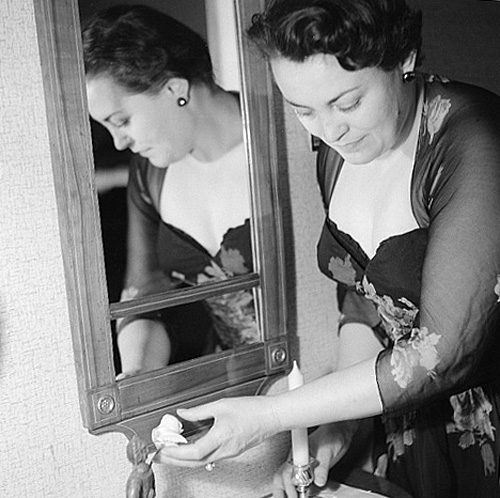
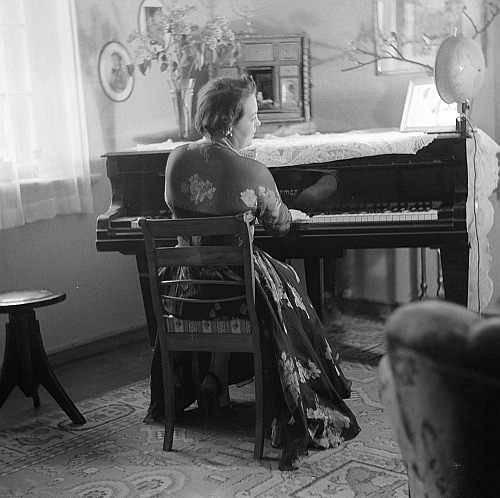
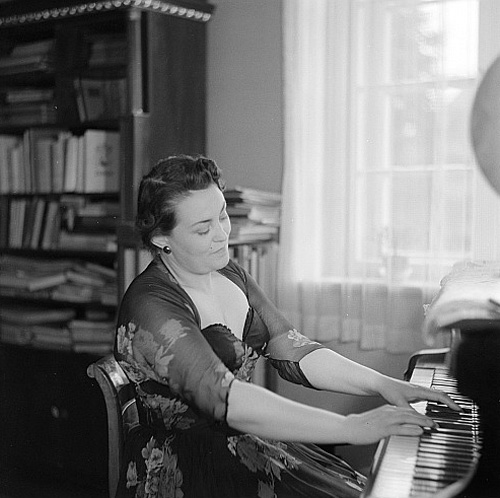
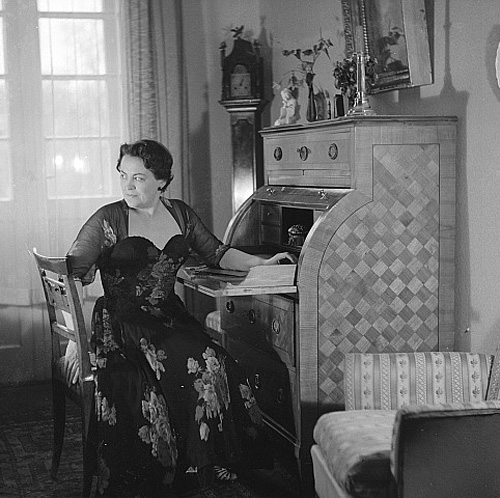
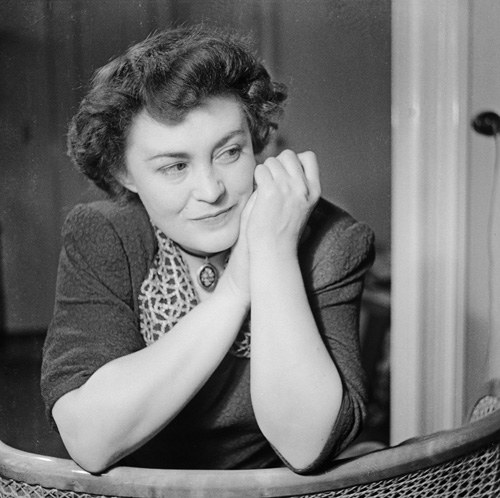
Fotoserie von Hildegard Jäckel, aufgenommen 1950 in Dresden-Weißer Hirsch, Plattleite 25,
→ WEITER: SINGING WITH SOUL
More Content on Elfride Trötschel
| → | UNDER THE SPELL OF A VOICE by Steffen Lieberwirth |
| → | SINGING WITH SOUL … THAT MELANCHOLY UNDERCURRENT by Jens Uwe Völmecke |
| → | ELFRIDE TRÖTSCHEL – OPERAS ROLL |
Link-Tipps
| ← | SEMPEROPER EDITION |
| ← | REGISTER-SEITE “MITTELDEUTSCHE OPERNSÄNGER” |
CDs mit Elfride Trötschel
 |
Antonín Dvořák: RUSALKA Gesamtaufnahme von 1948 EDITION STAATSKAPELLE DRESDEN VOL. 6 |
 |
Leoš Janáček: KATJA KABANOWA Gesamtaufnahme von 1949 EDITION STAATSKAPELLE DRESDEN VOL. 16 |
 |
Antonin Dvořák: DER JAKOBINER Querschnitt 1944 EDITION STAATSKAPELLE DRESDEN VOL. 19 PH 07031 |
 |
Paul Hindemith: DIE JUNGE MAGD I Ernst Toch: DIE CHINESISCHE FLÖTE |
 |
Carl Maria von Weber: DER FREISCHÜTZ |
 |
“GOTT, WELCH DUNKEL HIER!” DIE STUNDE NULL Dresdner Opernszenen in ersten Rundfunkaufnahmen nach 1945 SEMPEROPER EDITION VOL. 1 HP 1007 |
 |
Ludwig van Beethoven: FIDELIO Unvollständige Gesamtaufnahme von 1948 |
 |
Carl Maria von Weber: DER FREISCHÜTZ Gesamtaufnahme von 1951 |
 |
ELFRIDE TRÖTSCHEL · Lied Bekenntnisse |
Sorry, the comment form is closed at this time.